Showing posts with label style aspects. Show all posts

Friday, June 15, 2012

Balancing Patterns

Last week I (hopefully) defined balance as a style term. It’s about taking the highs and lows of a style aspect and combining them to create an effective look that works right down the middle. Also last week, I couched the definition in terms of formality, like how you can “dress down the middle” by wearing a blazer with jeans. This week, I’ll attempt the same explanation, but in terms of pattern
Pattern, as I define it, is the repeated decorative design on a piece of clothing. You can have stripes, gingham, plaid, tye-dye (though hopefully not), or nothing at all. Walk into any menswear store and you’ll see dozens of products in varying patterns. 

gingham- a checked pattern, typically with white and a bold color. From J.Crew

plaid- a checkered, tartan pattern. From Gant Rugger

stripes- long, narrow bands of the same width. From Brooks Brothers

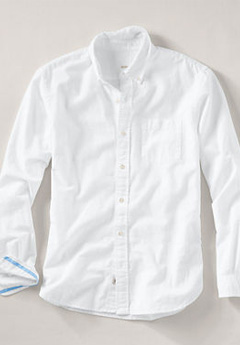
and of course, your plain colors. From Lands' End

Mixing and matching patterns is really a game played at the office. Casual outfits rarely encounter pattern problems, because typically the pants, be they jeans, shorts, chinos, or whatever, are found in a plain color. Finding the right shirt/tie combo however, is more likely to cause problems. 


…..except that it really won’t, as long as you strive to achieve balance of some sort. Check out these shirt/tie combos from a J.Crew ad. Notice how a patterned shirt is paired with a plain or solid tie, while a plain shirt is paired with a patterned tie. Mix subtle and bold patterns to strike a balance.  Not too hard, right? 

You can even mix and match the same patterns, as long as they're in different, corresponding sizes. The stripes on the shirt should be much smaller than those on the tie (although I'm not particularly fond of this look, that's not to say it can't be done). 


via Bloomberg Businessweek


As style novices, this should be enough to build some basic ideas around, so we'll stick with this for now. Once you get this down, you can start experimenting more by mixing patterns. For example, one of my favorite shirt/tie combos is a very soft, pink gingham shirt paired with a dark, evergreen plaid tie. 

Not the best picture, but you get the idea. Elements of pink in the tie help tie the two things together

Thanks for reading, and look out next week for more,
MD

Friday, June 8, 2012

Style Dictionary: Balance


Lately I’ve realized that I’ve been tending to write more concrete, what-to-wear or what-not-to-wear articles. And while that might be great for helping choose between two or three pieces of clothing, it’s not helping to build what my friend Robert, at Restart Your Style (which just launched this week and is looking quite good), would call “style basics.”
So today I’ll be explaining a term I’ve used often here at Midwest-Dressed: balance. In style terms, balance is about using two differently styled pieces together in correct proportions to establish an even distribution among the whole outfit. When done correctly, you can take two different, even competing style pieces, and make them work together to compliment each other in a good looking outfit. A rudimentary example:

There are many aspects of menswear by which a garment can be judged (“style aspects”). Color, size, pattern, fabric, weave, etc. can all be determinative in what you’ll wear and what you’ll wear it with (I’ll try to delve into these every week). 
For now though, let’s talk about what I’ll call formality, for lack of a better term. Essentially what I mean is, how dressy is the piece, and where is it appropriate to wear. A t-shirt would rank on the casual end of the formality spectrum, because it is very casual and chances are you wouldn’t (and shouldn’t) be wearing it to the office, a wedding, etc.

More casual

In contrast, a tuxedo is consider very formal, and the wearing of one is reserved for special occasions. For most guys, a suit ranks just a step below, relegated to either office-wear or classy nightlife events. 

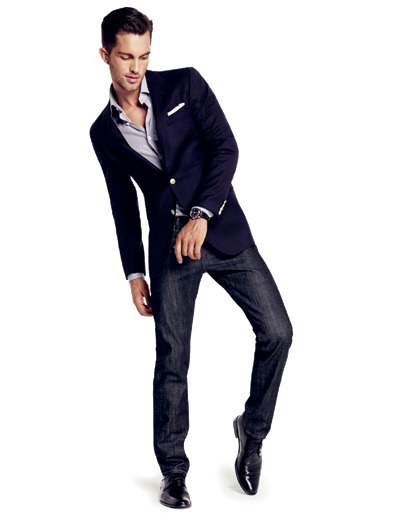
More formal- definitely office appropriate, depending on the office

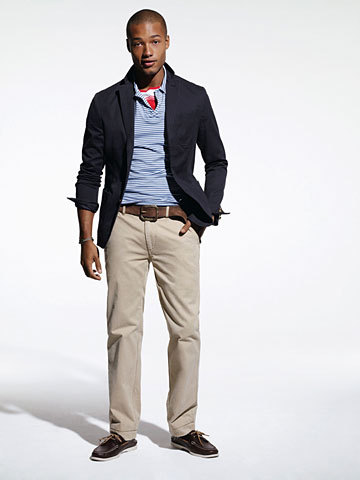
When you’re trying to balance an outfit’s formality, you’re taking two different pieces and combining them to compliment each other. It’s what Dan at TheStyleBlogger calls, “dressing down the middle,” which I like. In our example, the jacket adds a bit of formality, while jeans and a t-shirt or OCBD keep it casual. The formal aspect adds a touch of class, while the casual aspect keeps it from being too uptight. It’s stylish enough to wear out at night, but easy-going enough to wear while bouncing around town. 

Down the middle

Down the middle

Again, balance can be achieved in many “style aspects.” In terms of formality, “dressing down the middle” is a great trick because it’s so versatile. You can get dressed in the morning and wear the same thing throughout the day and into the night (at least in this example). 
In another example from one of my previous posts, you can balance the youthful, casual look of sneakers by pairing them with something more formal, more put-together up top. Balance is achieved because the two pieces come from different ends of the style spectrum, but they’re put together in correct proportions to achieve an even distribution of high-low. The same can be done with color, size, pattern, fabric, etc., which I will get into in coming weeks. 
One last thing (and this is where it gets tricky): Your outfit as a whole should be balanced as well. By this I mean, you don’t want too many “style aspects” battling each other. Think of each piece of clothing as a player on a team; you want the team, as a whole, to function and work effectively. You shouldn’t have colors competing with patterns competing with casual, that by itself is already competing with something formal. That’s too much going on. If you’re a beginner to style, pick one aspect to experiment with. Today’s discussion on formality dealt with strictly that. The colors here are neutral, the patterns muted. 
Thanks for reading,
MD

(All photos from GQ, because I’ll be damned if they’re usually the only people who have pictures of exactly what I’m talking about)